Top 10 AI Virtual Assistants in Australia (2025 Edition)


As AI evolves in 2025, businesses, from solo entrepreneurs to mid-sized organisations, are increasingly using AI-powered virtual assistants to automate routine tasks, manage communications, and improve efficiency. These tools handle everything from appointment scheduling and CRM updates to customer messaging and data entry.
Australia’s growing AI ecosystem includes local and offshore services tailored to regional needs. Professionals now expect virtual assistants to be flexible, compliant with the Privacy Act 1988, and responsive during AEST business hours. This guide presents the top 10 AI virtual assistant solutions available in Australia in 2025, chosen for their automation capabilities, productivity benefits, and local suitability. Leading the lineup is Podium Australia, with its intelligent, conversational AI and strong regional support.
Who Should Use an AI Virtual Assistant in Australia?
AI virtual assistants are made for businesses that struggle to keep up with customer demand, internal admin, or time-sensitive communication. They help out with response speed and consistency, directly affecting revenue as well as your customer experience.
Australian businesses get more from AI virtual assistants when they manage high volumes of enquiries across SMS, web chat, social messaging, or booking forms (especially outside standard business hours). Included in this is service-based industries, clinics, dealerships and multi-location operators where missed calls or slow follow-ups mean lost opportunity.
AI virtual assistants make sense when human teams are stretched thin, when growth has outpaced staffing capacity, or when customers expect immediate responses regardless of time or channel. The best way to think of an AI assistant is as a tool to help you absorb volume and maintain consistency, not something to replace judgement or relationship-building.
AI-First vs Human VAs vs Hybrid Models: What’s the Difference?
Not all “virtual assistants” are built the same. Knowing this early-on and understanding the difference between AI-first, human-led, and hybrid models is the first step in comparing tools.
- AI-first virtual assistants are software-driven systems enabling you to respond instantly, operate continuously and handle more interactions without tiring out. They scale easily, cost less over time at higher volumes and are great for customer messaging, bookings, follow-ups and workflow automation.
- Human virtual assistants rely primarily on people to complete tasks. They thrive when it comes to the nuanced admin work, bespoke processes, or judgement-based activities. Still, they’re limited by availability, cost per hour and response speed. Scaling also means adding more staff.
- Hybrid models combine both approaches. AI handles routine or time-sensitive work such as triaging messages or scheduling, while humans step in for complex tasks. These models work well for businesses transitioning from manual processes to automation but still needing human oversight.
Understanding where each provider sits on this spectrum helps avoid mismatched expectations around cost, scalability, and performance.
#1 Podium Australia
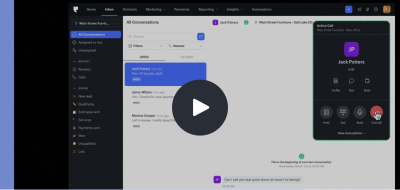
Podium Virtual Employee delivers AI-powered virtual assistance for customer messaging, appointment bookings, task automation, and performance tracking, all from a unified inbox.
Key Features
- AI-driven task automation and conversation handling
- Multichannel messaging across SMS, chat, and Facebook
- Smart calendar and CRM updates
- NLP for natural language interactions
- Image recognition for richer engagements
Why It’s Great for Australian Businesses
Podium is fully compliant with Australian privacy standards and offers support aligned with Eastern Australian time zones. It’s widely used across industries like automotive, healthcare, HVAC, plumbing and electrical, delivering intelligent automation that handles Aussie customer expectations seamlessly.
Pros and Cons
Pros: Scalable AI automation, Local support and timezone coverage
Cons: Pricing depends on usage
Best For
SMEs, clinics, retail, and trades businesses seeking smart automation and conversational AI.
#2 Virtually Yours
Virtually Yours offers Australian-based human VAs, but it’s enhanced with AI tools that cover scheduling, communication, and admin support.
Key Features
- Task automation through G Suite, CRM integrations.
- Customised human match-up.
- In-box and calendar management.
Why It’s Great for Australian Businesses
This tool was originally established in Australia, so their services reflect factors like local business culture and timezone considerations. They also combine human intelligence with optional AI tools for an all round powerful platform.
Pros and Cons
Pros: Local expertise, flexible task options.
Cons: Limited AI focus compared to AI-first platforms.
Best For: Entrepreneurs and consultants requiring personalised admin support.
#3 My Cloud Assistant
My Cloud Assistant is a combination of dedicated VA support with AI-enhanced admin systems. This makes it a great option for those looking to manage CRM, scheduling, and messaging tasks.
Key Features
- AI-assisted workflows.
- Integration with email, calendars, CRMs.
- Australian account overseers.
Why It’s Great for Australian Businesses
It’s made to support Australian SMEs with timezone-aligned service and data practices.
The Good and the Bad
Pros: Dedicated support, hybrid service model.
Cons: Requires manual AI implementation.
Best For: SMEs and startups wanting hands-on admin support with AI efficiency.
AI Virtual Assistants and Australian Privacy Compliance
Australian businesses using AI virtual assistants should always consider more than just features and automation. Data handling and privacy obligations are a big part of why your customers choose your business.
Under the Privacy Act 1988, businesses are responsible for how customer data is collected, stored and processed. This doesn’t change, even when third-party tools are involved. This includes messages, booking details, images and payment-related communications handled by virtual assistants.
Some of the main considerations include where data is hosted, whether processing occurs offshore, how consent is managed, or how access is controlled. Ask vendors how customer data is stored, whether subcontractors are involved, how long data is retained and what safeguards exist against unauthorised access.
For customer-facing AI assistants, transparency really matters. Customers should know when they are interacting with an automated system and how their information is being used. Strong compliance practices reduce risk, protect brand trust, and prevent avoidable issues as AI adoption grows.
#4 VA Platinum
VA Platinum mixes virtual executive assistants with AI tools for scheduling and CRM entry. Here, the focus is mainly on real estate and legal markets.
Key Features
- AI-enhanced inbox/calendar management.
- CRM data entry and workflow integration.
Why It’s Great for Australian Businesses
VA Platinum is popular among real estate and legal firms in Australia, therefore it’s packed full of industry-specific automation capabilities to give you the support you need.
The Good and the Bad
Pros: Industry expertise, scalable support.
Cons: Less conversational AI focus
Best For: Real estate agents and legal professionals.
#5 Virtual Coworker
Virtual Coworker provides remote VAs for admin, CRM updates, marketing tasks, with AI tools to optimise workflows.
Key Features
- AI task automation.
- CRM and email campaign support.
- Australian-led onboarding.
Why It’s Great for Australian Businesses
Australian job matching and timezone-aware support make it a dependable option for long-term operations.
The Good and the Bad
Pros: Local quality control, flexible hours
Cons: Human-led vs AI-first focus
Best For: Agencies and distributed operations requiring daily support.
#6 Remote CoWorker
Remote CoWorker offers AI-augmented assistant services that are great for ecommerce, admin, and scheduling tasks.
Key Features
- AI for follow-ups and scheduling.
- Ecommerce task handling.
- Chat/email support assistance.
Why It’s Great for Australian Businesses
Well-suited for Australian ecommerce and digital services looking for blended AI-human support.
Pros and Cons
Pros: Hybrid model, ecommerce-ready.
Cons: International rather than local AU HQ.
Best For: Ecommerce shops and digital-first startups.
#7 Task Bullet
Task Bullet combines virtual assistants with AI workflow tools and task buckets for a time management solution that’s all about flexibility.
Key Features
- CRM support and data entry.
- AI scheduling reminders.
- Client task delegation.
Why It’s Great for Australian Businesses
It’s used widely by Australian clients and is best suited for general and varied task needs.
Pros and Cons
Pros: Hourly flexibility, task management.
Cons: Limited direct AI conversation features.
Best For: Businesses with ad-hoc task requirements.
#8 OkayRelax
OkayRelax is a perfect balance of human VA support with basic AI tools for scheduling and email management.
Key Features
- Automated scheduling and reminders.
- Business and personal admin help.
- CRM/data integration.
Why It’s Great for Australian Businesses
Affordable and straightforward, it’s a solid entry-level option for small-scale Australian users.
The Good and the Bad
Pros: Budget-friendly, intuitive
Cons: Light on deep AI automation
Best For: Freelancers and solo professionals with light admin needs.
#9 Pepper Virtual Assistants
Pepper VA offers traditional VA services with light AI enhancements for scheduling and data tasks.
Key Features
- Gmail/Calendar automation.
- Task templating.
- Customer service and CRM input.
Why It’s Great for Australian Businesses
This tool is widely used by startups and small enterprises across Australia, mostly because it’s known for its cost-effectiveness.
The Good and the Bad
Pros: Affordable and well-rounded.
Cons: Less AI-driven than peers
Best For: Small businesses testing VA functionality.
#10 24/7 Virtual Assistant
24/7 VA combines round-the-clock human assistants with AI tools for scheduling and communications.
Key Features
- 24/7 coverage.
- AI scheduling and customer messaging.
- Task handling across ecommerce, real estate, finance.
Why It’s Great for Australian Businesses
Provides international coverage with workflow automation suited to after-hours needs.
The Good and the Bad
Pros: Non-stop availability, multi-role capability
Cons: No direct Australian presence
Best For: Global-facing or overnight-reliant businesses.
Industry-Specific AI Virtual Assistant Use Cases in Australia
AI virtual assistants deliver the strongest results when applied to industry-specific workflows rather than generic admin tasks.
- In healthcare and allied health, AI assistants manage appointment scheduling, confirmations, recalls, and after-hours enquiries, reducing front-desk load while maintaining consistency and patient access.
- For trades and home services, they handle missed calls, job enquiries, quote follow-ups, and booking coordination. This is especially valuable in Australia, where many enquiries occur outside standard working hours.
- In automotive businesses, AI assistants respond to vehicle enquiries, book test drives or services, follow up on leads, and route conversations to the correct location or department.
- Ecommerce businesses use AI assistants to answer product questions, track orders, manage delivery updates, and recover abandoned conversations at scale.
- Professional services rely on AI assistants to triage enquiries, qualify leads, manage calendars, and ensure no prospective client waits days for a response.
These use cases show how AI assistants move beyond basic admin into revenue protection and customer experience improvement.
How to Choose the Right AI Virtual Assistant for Your Business
Choosing the right AI virtual assistant starts with understanding your operational reality, not just feature lists.
Think about your business size and enquiry volume. High interaction volumes favour AI-first platforms that scale without linear cost increases. Smaller teams should prioritise ease of setup and automation depth over customisation.
Assess how customers contact you. Businesses relying on SMS, web chat, or missed-call recovery need assistants that operate across channels with full context. Compliance requirements also matter. Healthcare, finance, and service industries should prioritise vendors with strong Australian privacy alignment.
Finally, weigh budget against long-term efficiency. Cheaper human-led solutions may work short term, but AI-driven platforms often deliver better ROI as volume grows by reducing manual effort and response delays.
The best choice is the one that fits your workflow today while supporting growth tomorrow.
Unlock Your Business’s Potential With AI
AI-powered virtual assistants boost productivity, keep you compliant, and create a customer service that’s memorable and completely personal. From solo entrepreneurs to fast-growing SMEs, everyone can see the benefits of implementing them into their business.
But what’s the right choice? Podium Australia stands out in 2025 for offering intelligent, contextual, and regionally responsive AI support. It’s the go-to for any local businesses seeking smart automation and genuine customer engagement. Change the way you communicate with customers today, and reap the rewards tomorrow.