How to Get a Toll Free Business 1800 Number: A Guide


1-800 numbers are the code that most people think of when they think of toll-free numbers. If you choose to get a toll-free number for your business, you will make it easier for your customers to reach you. That is because it will not cost them anything to call you. This adds a level of convenience for customers and puts your business in a better light.
Thanks to the fact that calls to toll-free numbers are free to make, these are also a great way to attract future clients. If you and a competitor are otherwise equal in your offerings, the free calls may push you ahead.
What are toll-free numbers?
Toll-free numbers are numbers that are free to call from a landline. The idea behind a toll-free number for business is that because it is free to call, there are no long-distance fees. This makes it much easier and more affordable for customers to contact a business, even if they are in different areas of the country or have different area codes.
It is worth noting that while a toll-free number for business is free to call from a landline, it will still come with normal charges from a cell phone. This is typically in the form of using up minutes, unless the caller has a plan with unlimited calls.
When business owners and merchants think about toll-free numbers, they likely start wondering how to get a 1-800 number. This is because “1-800” was the first three-digit code to be reserved for toll-free numbers. Over time, however, demand for such numbers grew, and so did the list of potential prefixes. Now, you can also get a toll-free number that starts with:
- 800
- 833
- 844
- 855
- 866
- 877
- 888
The following image shows when the new prefixes were added:
What is an Australian 1800 number?
In Australia, freephone numbers begin with 1800. The Australian Communications and Media Authority (ACMA) classifies them as freephone numbers, and the caller generally pays nothing, including when calling from a mobile, although individual telco plan conditions can apply. An 1800 number isn’t tied to any geographic area. It works the same whether your customer is in Cairns or Hobart, and it does not change if you relocate. Behind the scenes, the number simply routes to a phone service you already have, whether that is a mobile, a landline or a cloud based phone system.
It helps to know the neighbours. Numbers starting with 13 and 1300 are also national and location independent, but the caller pays for those, usually at a local call rate or out of their plan’s included calls. The 1800 prefix is the one where the business picks up the full cost of the call, which is exactly why it reads as “we want to hear from you” to the person dialling.
1800 vs 1300 vs local business numbers
The three main options each say something different to the customer. An 1800 number is free for the caller and suits a business that wants a national contact point and is happy to absorb the call cost. A 1300 number also gives you a national presence, but the caller pays according to their telco or included plan, which keeps your inbound bill lower. A local number starting with 02, 03, 07 or 08 tells people where you are, which is an advantage if most of your customers are around the corner and want to deal with a local business.
Which one is best depends on where your customers are, whether you want to look local or national, how many calls you expect, what your provider charges for inbound calls, and how you need calls routed. A single location plumber probably wants a local number, or a 1300 number if they cover a wide area. A business selling Australia wide with a support line is a stronger case for 1800. Plenty of businesses run more than one and put the right number on the right marketing.
How do I get a toll-free number step-by-step?
The following steps will walk you through the process of how to get a 1-800 toll-free number.
Step 1
The first step in how to get a 1-800 number for your business is to figure out which Responsible Organization (RespOrg) you want to use. The FTC has a list of toll-free service providers (RespOrgs) on their SOMOS website.
You can also just do a simple online search to find a service provider.
This is a very important step of the process, as the service provider you choose will determine your costs, minutes, customer support, features, and more. When comparing RespOrgs, consider the following toll-free number features in addition to pricing and the number of minutes included:
- Voice-to-email
- Caller ID
- Voicemail
- Call forwarding
- Auto-attendant service
- Custom service
Step 2
After you choose which toll-free service provider you want to use, it is time to choose a phone number. The good news is that the FTC makes it illegal for providers to “hoard” numbers. In other words, all RespOrgs should have access to the same numbers until one is claimed. This is very helpful if you are interested in vanity toll-free numbers.
You will start the number-selection part of how to get a toll-free number for your business by choosing a prefix. This is when you can choose 833, 844, 855, 866, 877, or 888 if you don’t want an 800 number.
Once you choose a prefix, you will see some options for your full toll-free number. Choose one that you like.
Step 3
Finally, you will have to decide on the plan or package that your business needs. Carefully evaluate the options to figure out which package is best for your company.
Step 4
At this point, your number is ready. All that is left is to set up call forwarding or any other features that you need from your existing phone numbers. Most businesses will need to set up call forwarding right away to start making and receiving messages.
How to get an 1800 number in Australia
Start by comparing Australian telecommunications or business phone providers that offer 1800 services. Check the numbers they have available, or decide whether you want a Smartnumber: a memorable 13, 1300 or 1800 number allocated through ACMA’s numbering system that spells a word or follows a pattern, in the style of 1300 FLIGHT. Then compare the things that drive the cost: setup fees, monthly charges, inbound call rates, the features included and the contract term.
Once you have picked a provider and a number, decide where calls should go. That could be a mobile, a landline, a call centre or a cloud phone system, and it can change later. Configure the features you need, such as call forwarding, voicemail, business hours routing, queues or automated menus. Then test the number properly from a mobile and a landline before it goes on your website, vehicles or ads.
What does an 1800 number cost?
Published prices go stale quickly, so it’s more useful to understand how the pricing is built. Most providers charge an initial setup or connection fee, a monthly service charge, and then a per minute or per call rate for the incoming calls you receive. Some charge different rates depending on whether the call came from a mobile or a landline. Advanced routing, call recording, analytics, CRM integrations and extra users usually cost more on top. If you want a memorable Smartnumber, expect an additional charge, as ACMA currently applies different allocation charges depending on how memorable the number is.
The trap is comparing providers on the advertised monthly fee alone. A cheap plan with a high inbound rate can cost far more than a dearer plan with included minutes once you are taking real call volumes. Estimate how many calls you expect each month and roughly how long they run, then compare total monthly cost on that basis.
FAQs on getting a toll-free number for business
Can I record calls on my toll-free number for customer support?
Yes, you can record calls on your toll-free number. You can do so as long as you follow all of the local guidelines regarding consent for recording calls. It is crucial to check your local laws before recording calls.
Depending on where you live, you may have one-party consent laws or need consent from the caller. This is good news, as most companies want to record calls for the reasons shown in the following image:
How is a toll-free number different from a local number?
There are two main differences between local numbers and toll-free numbers. To start, the first three digits (or area code) of a toll-free number will be 1-800 or another one of the designated toll-free prefixes. By contrast, a local number will have a local area code. This means that if you call someone from a toll-free number, they will not know where you are calling from.
The other difference is that it is free to call a toll-free number from a landline, no matter where in the country you are. By contrast, depending on where you are, you may have to pay long-distance fees if you call a local number from a landline.
What about vanity numbers?
A vanity number is when you choose the digits in your phone number. Businesses will frequently do this to spell out a name, acronym, or word or just to make their number easier to remember. Examples include 1-888-NEW-CARS and 1-800-FLOWERS. Businesses can get these numbers through a toll-free number service.
Can I send or receive text messages using my 800 toll-free number?
Yes, you can use your 1-800 number to send or receive calls or text messages. However, it is important to note that to receive and send text messages on a toll-free number, you need to get a “text enabled” number.
Can I get a toll-free number even if I am located internationally?
Yes, you can get a toll-free number if you are located internationally. However, in most cases, that toll-free number would be for the country that you are located in. Customers calling you from another country would have to pay to call you.
You can get around this with an international toll-free number. These are slightly more expensive but will be free for international customers to call.
How much does it cost to get a 1-800 number?
The cost to get a 1-800 number will depend on the plan that you choose. Expect to pay at least $13 a month. That being said, you can find plans for as little as $10 a month. On top of that, expect to pay 6 to 30 cents per minute.
What features should you look for in an 1800 business phone service?
Voicemail and call forwarding are the minimum. Beyond those, compare providers on business hours routing so that after hours calls go somewhere sensible, an auto attendant or interactive voice response menu, call queues for busy periods and missed call notifications.
Then look at the operational side: call analytics, integration with your CRM or customer messaging platform, access from both mobile and desktop, and call recording where it is legally appropriate. Finally, confirm you can port the number away if you change providers later.
Match the list to how your business handles enquiries rather than buying every feature on offer. A small local operation may only need forwarding and voicemail. A business with several locations or a sales team is more likely to need queues, routing rules, reporting and a shared view of customer history, so that whoever answers knows what the last conversation was about.
Can you keep your 1800 number if you change providers?
Yes, in most cases. Australian freephone 1800 numbers can generally be ported between telcos under the Inbound Number Portability Code, so you are not locked in to the provider you started with. The number normally needs to stay active during the transfer, and the new provider handles most of the process. Because the number ends up on your signage, ads and website, this matters more than it might seem. Losing it would mean reprinting everything and hoping customers find the new one.
A few things to check before you start. Do not disconnect your existing service until the port is confirmed complete, or the number may be lost. Read the contract with your current provider for any minimum term or exit fees. And ask the new provider what happens to calls during the transfer window so you are not caught with a dead line for a day.
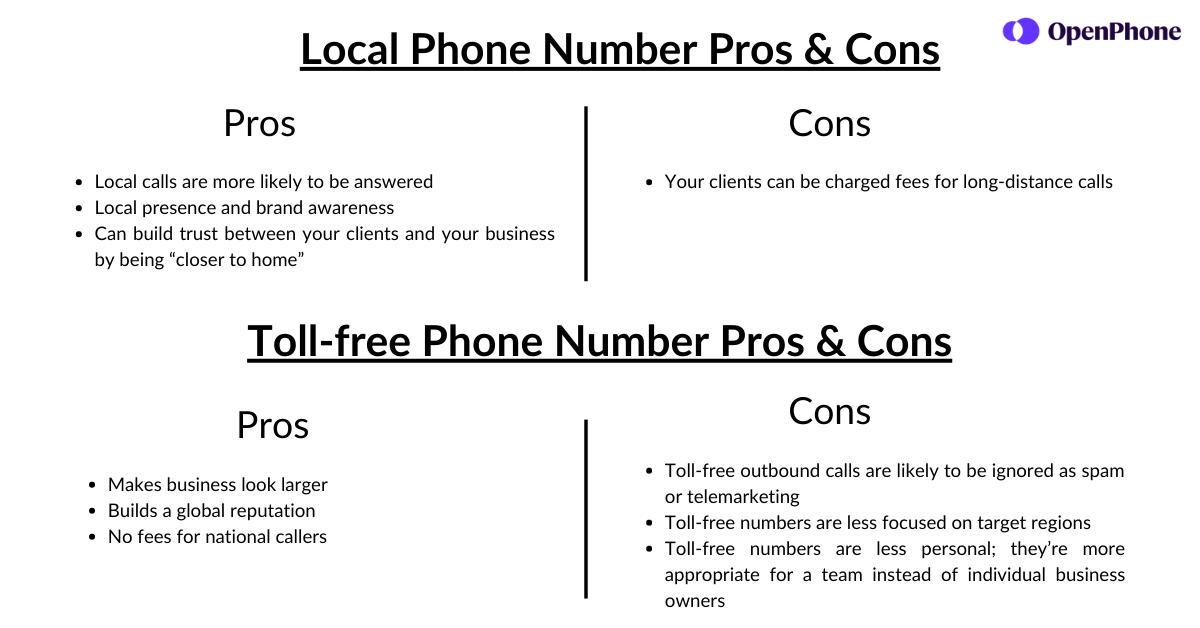
Do I Need a Toll-Free Phone Number for My Business? The Impact of Getting a Toll-Free Number
Pros
If you get an 800 toll-free number for your business, you will notice several important benefits. To start, customers will not have to spend to contact you for business calls. This will improve the customer experience. That, in turn, should boost customer loyalty and retention while increasing referrals and positive reviews.
Getting a toll-free number for your business can also add legitimacy to your company. People see companies with an 800 toll-free number as being more established. Customers can call your toll-free number from anywhere in the world, as long as they use the appropriate country code. Just keep in mind that callers do typically have to pay for international calls to 1-800 numbers.
It is also incredibly easy to get a toll-free number. Many services let you easily get them instantly. There is also the option to get a vanity number, which makes it much easier for customers to remember your number.
When you get a toll-free number, you will also likely be able to set up call forwarding. This lets you forward calls to another landline or a VoIP phone, so you never miss a call.
Toll-free numbers help ensure that your business is future-proof, specifically if you move. If you move to a new area code, you would have to change your local number. That’s not the case with a toll-free number. This saves you the hassle of notifying customers and the risk of losing customers due to the change in your business phone number.
Another benefit of toll-free numbers is that they can be ported. This means that you can switch from one RespOrg to another and continue using your existing toll-free number.
Cons
Opting for a local number instead of a toll-free one can improve customer loyalty and interest by making you seem like a part of the community. Sometimes, people prefer to interact with local businesses instead of ones that are far from them.
Some people may also have negative assumptions about calls from a toll-free number. This could affect the effectiveness of your marketing campaigns.
Conclusion
The need to get a 1-800 number may depend on the type of business and customers you have. If you have customers in various regions or you want to make your company seem more established or professional, then it makes sense to get one.
However, you may also want to maintain a local number to encourage potential customers to see you as a local business worthy of support. See how Podium can help your business and book a demo today.